
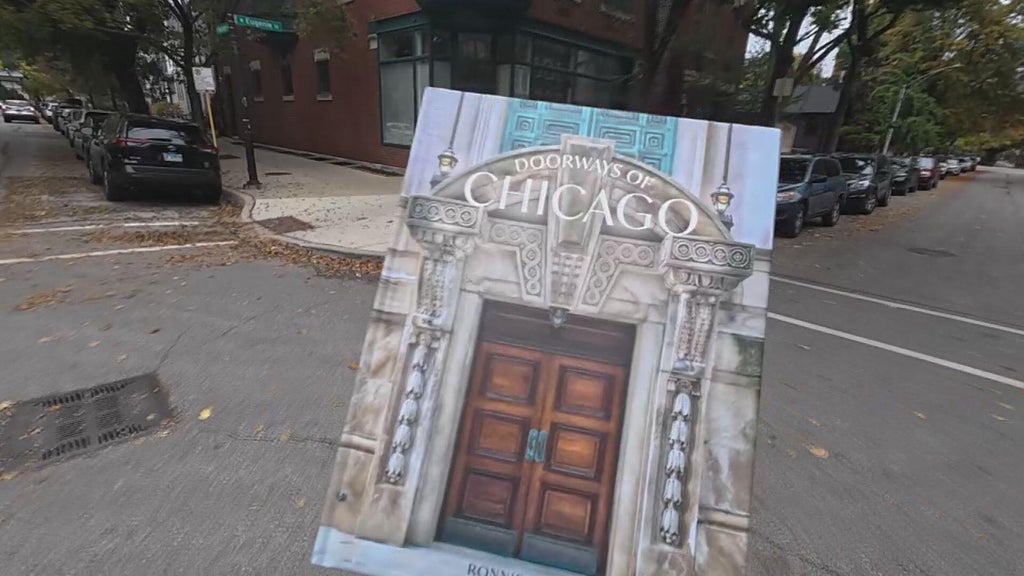
Some of the most fascinating Chicago history can be found in places we might walk past without a second glance. Photographer and author Ronnie Frey reveals those hidden stories in his new book "Doorways of Chicago."
Some have stood for more than a century. Others hold secrets about people whose contributions helped shape our city and country. Each door is a work of art with a story to tell.
What inspired Frey to photograph Chicago doorways?
"It really started during the pandemic. I started wandering around just to get out of the house," he said.
That wandering, using his iPhone, led to an Instagram account, tours, and a book called "Doorways of Chicago," featuring about 40 Chicago neighborhoods.
"I have 75,000 photos on my photo roll," Frey said. "We paired them kind of like shape and color."
Frey said some doorways offer a fascinating look into the past.
One of those doors is at the Henry Gerber House, a national historic landmark at 1710 N. Crilly Ct., on a quiet private street in Old Town.
Behind the house's doorway, Gerber made history in 1924, founding the nation's first chartered gay rights organization, the Society for Human Rights.
"He's really considered to be the first gay activist in the United States," Frey said. "He was a postal worker, and so they would have private secret meetings in the basement here, but the police got wind of this, and they showed up one night with a Hearst reporter. They knocked his door down, drug him out of bed, and threw him in jail for this activity, and then after he got out of jail he lost his job as a postal worker."
Just across from the Henry Gerber House, the doorways of the Crilly Court Apartments tell another story. Developer Daniel Crilly built the residential community after the Great Chicago Fire.
"The demand for housing was so high that there were just developers just building all over the city in just record time," Frey said.
There's a personal touch at those apartments. The names of Crilly's children are above each entrance.
"The story of how Chicago went from farmland to bustling city in 60 short years is literally carved into these doorways forever," Frey said.
With that attention to detail, only certain materials were used.
"You have all this brick and limestone, and it's really because that's why we have a lot of that in Chicago, because it's fireproof," Frey said.
Just blocks away is the Biddle House at 407 W. Eugenie St., the historic home of inventor and engineer Joseph O'Connell, known for advancing telephone technology.
"He invented this thing called the invisible wire, so it was the first time people could have a private telephone line," Frey said.
O'Connell lived in the house for more than 90 years. The engineer and inventor worked for Illinois Bell.
"He also invented the circuit breaker. He invented the little switchboard lights that they used on switchboards so people could see what line was coming in," Frey said.
In Uptown, at 1345 W. Argyle St., is the home of Essanay Studios, a Chicago landmark, where the doorway features a pair of carved images of a Native American wearing a warbonnet.
"A guy named George Spoor and Gilbert Anderson were the founders, and the name is the combination of the initials of their last two names – S and A," Frey said. "The Indian heads are their logo."
Before Hollywood became synonymous with filmmaking, it was Chicago leading the way. Essanay Studios helped make stars of the likes of Charlie Chaplin and Gloria Swanson.
In the heart of downtown Chicago, at 1 S. State St., is the Sullivan Center, formerly known as the Carson Pirie Scott Building, another Chiago landmark and national historic landmark.
Architect Louis Henry Sullivan designed the building's extraordinary entrance for the Carson Pirie Scott department store. Hidden among the intricate ironwork are his initials, LHS.
"You have these pockets of really, really intricate details that are very organic shaped, and almost lomd of art nouveau shaped," Frey said. "No computers back then, so all would have had to been hand drawn, and then those drawings would have been taken to a fabricator, who probably had a few swear words to say, but they made it and it's really amazing."
Frey said each doorway in his book reminds us about the history and beauty around us and to take the time, to embrace it.


