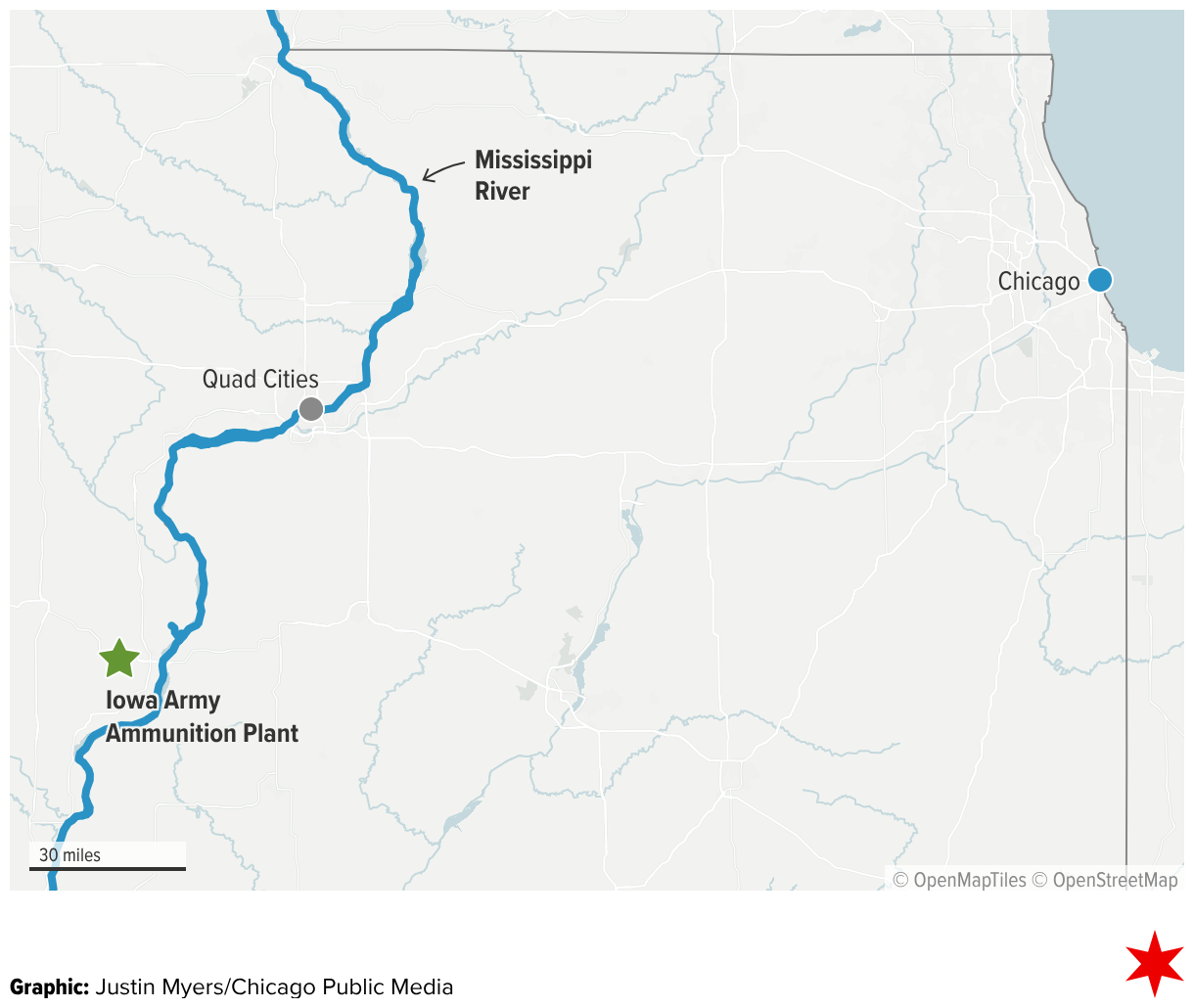
The U.S. Army is scheduled to detonate a stockpile of lead azide, a chemical used for making bombs, on Wednesday at approximately 9:00 am in Middletown, Iowa, about 80 miles southwest of the Quad Cities.
The explosion is expected to create a dust plume containing lead. Lead is toxic to humans and animals.
On Monday afternoon a federal appeals court cleared the way for the detonation. The order by the 8th Circuit U.S. Court of Appeals was one of two decisions President Donald Trump said he was awaiting after he ordered the Army earlier in the day not to detonate the chemicals without court approval, according to the Associated Press.
Trump had weighed in on social media, saying he would defer to the courts on whether the administration should move ahead. He also said in a statement that his decision was subject to agreement by Iowa Gov.-elect Rob Sand. Though if Sand and the court don't agree, Trump said, the administration would not proceed with the detonation. He said he would hold Sand responsible.
The Army moved the planned explosion from Friday to Monday before pushing it to Wednesday after politicians from Iowa and Illinois asked for a delay and environmental groups filed a lawsuit to pause the detonation. Wednesday was chosen for optimal weather conditions, the Army said.
A Sierra Club attorney had said on Sunday that it was it unclear whether a court order temporarily putting on hold the Army’s EPA permit would prevent the Army from detonating the toxic material.
Here’s what else you need to know.
There’s a risk that these stored materials will detonate on their own, and moving them could also trigger an explosion, according to the Defense Department. The issue was discovered earlier this year and plans to blow them up have been ongoing for months.
The detonation is expected to take place at the Iowa Army Ammunition Plant in Middletown, Iowa on Wednesday at approximately 9:00 am, the Army said. The plant is around 80 miles southwest of the Quad Cities and only about 10 miles west of rural Illinois communities just across the Mississippi River.
The Army delayed the planned explosion after politicians raised concerns about safety. Both the outgoing Republican governor of Iowa and the newly elected Democratic governor called for a delay. They were joined by other politicians in both states. The environmental organization Earthjustice also sued to try to pause the detonation.
While the Army has destroyed weapons and materials in the past, it has never blown up such a large amount of this particular chemical, according to a spokesperson.
“We detonate all the time, but we have not detonated lead azide at this quantity,” said Lori McFate, public affairs specialist with the Army Sustainment Command in Bettendorf, Iowa.
McFate said the explosion will take place after months of planning. The procedure has received a green light from the U.S. Environmental Protection Agency regional office in Kansas City. That’s a different jurisdiction than the regional EPA office in Chicago, which oversees environmental protection in Illinois.
Lead azide is a compound of lead and nitrogen, used to make bombs. About 5 tons of it will be blown up.
“The lead azide has aged. It's become unstable to the point where moving it or even allowing it to sit on the odd chance that it receives some sort of shock or friction could lead to a spontaneous explosion,” said Greg Domski, associate provost and professor of chemistry and biochemistry at Augustana College in Rock Island.
The lead dust is not expected to blow as far northeast as Chicago.
Illinois has created a webpage where residents can find the latest information on the situation. Current meteorological data for Wednesday, Nov. 25 on the site indicate Illinois is not expected to be affected by the detonation plume. The Illinois EPA and the Illinois Emergency Management Agency and Office of Homeland Security will continue monitoring conditions as forecasts and operational plans evolve.
Brian Pierce, a meteorologist with the National Weather Service Quad Cities forecast office said if the detonation takes place Wednesday, winds would blow the smoke into Iowa and potentially northeast Missouri.
“It would be blowing it to the southwest across the far southeast parts of Iowa,” Pierce said. “There’s a question of how high the plume would get, which we won’t know until it actually happens.”
The EPA says there is no safe level of lead exposure. It is a neurotoxin that damages the central nervous system. It’s particularly harmful to children as their brains and nervous systems aren’t fully developed. Exposure to lead is associated with cognitive delays, heart problems, and reproductive issues.
“Lead is an element, and doesn't break down,” said Robert Hirschfeld, director of water policy at the Prairie River Network, a Champaign-based environmental advocacy group.
“Those health risks persist as long as the lead does.”
As part of the controlled detonation, federal officials are installing air monitors and will conduct further environmental sampling of the blast area.
For locations that are likely to be affected, the agricultural impacts of the lead dust are still unknown, Hirschfeld said. “We’re past harvest now, and so all of that lead is going to land on bare soil and that lead will stay there and contaminate that soil.”
He said lead contamination could go beyond the potentially impacted farmland and crops, and trickle down to animals, whether livestock or wildlife, that graze on the land.
The Illinois Department of Public Health recommends the following safety tips:
Contributing: Isabela Nieto