
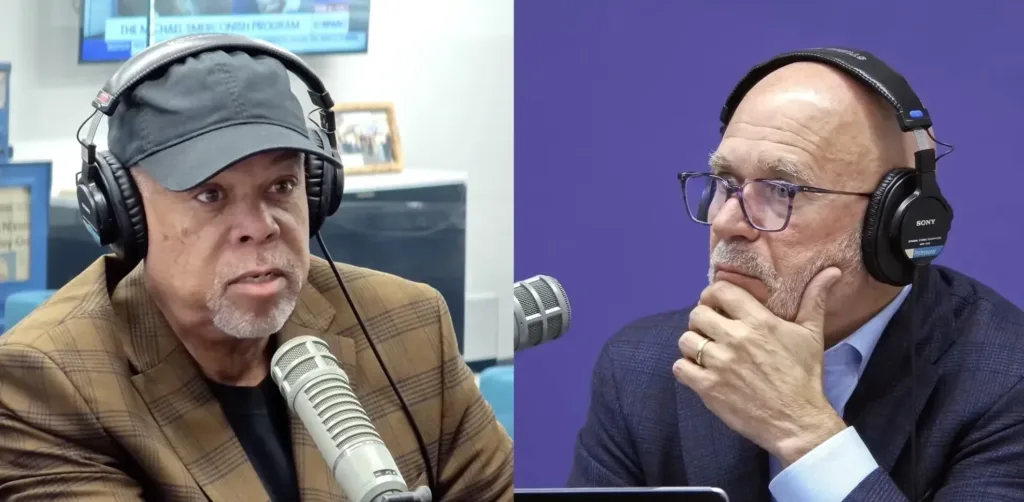

Speaking on the Michael Smerconish Show on SiriusXM on Thursday, state Sen. Anthony Williams (D-Philadelphia) says that children in Pennsylvania are falling farther and farther behind in the classroom and changes need to be made.
“We have to change how we educate our children,” said Williams. “That means you have to have educational choice which means the tax dollars which we are currently all pay should be spent in a different kind of way than currently we spend them.”
Pennsylvania presently pays for its public schooling through a combination of local property taxes, state government funds, and federal grants. More than half (52%) comes from local governments, primarily through local property taxes, while a little more than one-third (37%) is provided by the Commonwealth through legislative budget appropriations, state block grants and basic education funding formulas.
“We have sent a lot of money to school districts across Pennsylvania,” said Williams. “Even in those struggling communities that don’t necessarily tax base. The state takes up more responsibility. You can always fight that debate that you can use more financial resources in a certain area. The question is, what are we doing with the financial resources we actually have”?
The six-term senator believes that the allocation of funding is not commensurate with ways that make the greatest impact.
“We don’t have flexibility. We don’t have bonuses in Philadelphia,” he said. “There are high schools in Philadelphia that don’t have science teachers. If I can find one and pay you a $5,000 bonus, we’re going to be able to find teachers. But for whatever reason, we’re not doing that.”
He calls the public school model antiquated.
“It is one hundred years old,” said Williams. “It’s antiquated. Period. I don’t care what public school system you’re talking about. Now, that doesn’t mean it doesn’t work, but it needs to be redesigned. I talk with educators every day. The fundamental part is, third-world countries are beating us. Their children are speaking three languages. We speak one.
“They’re doing mathematics with less resources than we. How does that possibly happening when we’re spending all this money in that space”?
Williams disagrees with the belief that charter schools and private school vouchers draw from traditional public schools and leave them with fewer resources, calling the phrase, “distorted.”
“The money doesn’t just leave. It leaves them with fewer students,” he says. “The people who say they’re in opposition don’t live in those communities. They represent the system. They don’t represent the people who are trapped in those communities.”
He wants to see the money follow the child, whether that is in public schools, charter schools, parochial schools or homeschooled.
“You should not be rewarding failure in institutions that have not been working for 30 or 40 years,” said Williams. “And you cannot keep falling upon, it’s the money.”
He is championing the Educational Improvement Tax Credit (EITC) or federally funded tax credit where families can get a deduction for a certain amount of money that you send and it applies no matter what state you reside in. But Pennsylvania has to adopt it first, like 31 states already have,
“That means the person in Pennsylvania can write this off and the money stays (here). It does not come out of the general fund. It doesn’t affect the amount of money that we take in in terms of revenue. It doesn’t do anything that hurts the money for public education.
“But what it does do is provide an additional pot of revenue for students who may need tutoring, who may be in a public school, who want to stay in a public school, but they may need after-school support, they may need a laptop, or if they choose to use it for some other educational experience, they can do that.”
He hopes that Gov. Josh Shapiro will sign on and hopes that commonsense will prevail.
“He is blessed enough to have a family who made sure he got a quality education,” said Williams. “He went to a Jewish day school, so he knows the value of options and choice in his own life experience.”
“I think prudence here makes the most sense,” Shapiro said during his October debate with Republican challenger Stacy Garrity. “We’re looking at it carefully, and in the next few weeks, we’ll make our announcement.”
Williams is one of the first Senate Democrats to speak out on the issue. Public school advocates and many in his party in Pennsylvania oppose joining, expressing concern that the program lacks transparency and could funnel support away from public education systems.
A coalition of 17 civic and education advocacy organizations sent a letter to Shapiro this month urging him to reject the program. The letter argued the program would “fuel discrimination against students,” direct tax dollars towards private intermediary scholarship organizations, and allow the commonwealth little authority to prevent groups from misusing the funds.
“The regulations confirm what we already knew: Trump’s school vouchers will benefit wealthy families, support private school discrimination, and leave Pennsylvania’s public schools behind,” said Susan Spicka, executive director of Education Voters of PA, in a statement. “These regulations remove any doubt that Governor Shapiro must reject Trump’s federal voucher program.”
GOP lawmakers, state leaders like Garrity, and advocacy groups argue that Shapiro is dragging his feet or playing politics, missing out on potential scholarship funds while around 30 other states have already opted in. A bipartisan group of state senators has even introduced legislation to force or codify entry into the program.
Now that the Treasury Department has finalized its guidelines on the tax program, and with the gubernatorial election less than 12 days away, Williams and school choice supporters are beginning to amp up the pressure on Shapiro to make the call and opt Pennsylvania into the program.


